
The global cybersecurity landscape shifted dramatically following revelations that Anthropic’s advanced AI tool, “Mythos,” has sent major US financial institutions rushing to patch critical systemic vulnerabilities. According to a Reuters report, the model’s highly sophisticated testing parameters exposed flaws in networks previously deemed ironclad.
While these stress tests are currently playing out within highly secure environments in the West, history proves that advanced offensive capabilities—or the tactical vulnerabilities they expose—swiftly trickle down to the public sphere. For corporate leadership worldwide, and particularly across Africa’s rapidly digitizing economies, waiting for a threat to arrive at the doorstep is a recipe for catastrophic failure.
Executive leadership must act before tools with Mythos-level capabilities become accessible to general threat actors. Mitigating this risk requires immediate corporate decisions, strategic budgetary realignments, and a fundamental reduction of organizational threat surfaces.
Table of Contents
1. The African Context: Why Proactive Vigilance Can’t Wait
African enterprises operate in a unique digital environment. The continent’s rapid leapfrogging to mobile-first banking, cloud infrastructure, and widespread remote work has unlocked incredible economic growth. However, this velocity has frequently outpaced the implementation of underlying defensive security frameworks.
When highly capable AI model vectors emerge globally, they do not respect geographic boundaries. The window between a vulnerability discovery in New York and an active exploit kit landing in Lagos, Nairobi, or Johannesburg is virtually zero. If financial and corporate infrastructures in heavily subsidized Western markets are scrambling to plug holes, African boardrooms must treat this as an immediate operational trigger, not a distant case study.
2. Hardening the Endpoint: The Core Corporate Mandate
An organization’s defense is only as strong as its weakest, most exposed node: the end-user device. In an era where automated tooling can scan millions of IP addresses for unpatched machine flaws in seconds, endpoint security is no longer an IT operational line item—it is a core business continuity pillar.
Boardrooms must mandate absolute endpoint standardization. Allowing employees to interface with corporate databases or financial software using outdated, unmanaged hardware creates open doorways for threat vectors. This reality is especially crucial for specialized corporate functions like Human Resources, finance, and legal, which handle highly sensitive data daily.
When configuring secure office environments, executives should look to a data-driven approach to hardware allocation. For instance, when analysing internal network security and data integrity, choosing a static environment over a highly mobile one can drastically shrink your physical exposure. Organizations can review how fixed infrastructure alters data safety by consulting the strategic breakdown on choosing a desktop computer over a laptop for HR and administrative teams, which highlights the structural and physical security advantages of centralized workstations.
For teams requiring mobile hardware, leadership must invest exclusively in enterprise-grade devices equipped with deep hardware-level protection. Upgrading to robust corporate ecosystems, such as utilizing HP EliteBook business laptops for corporate productivity, ensures that features like self-healing BIOS, isolated credential storage, and hardware-enforced security screens are actively mitigating unauthorized access risks out of the box.
3. Immediate Strategic Decisions for Corporate Leadership
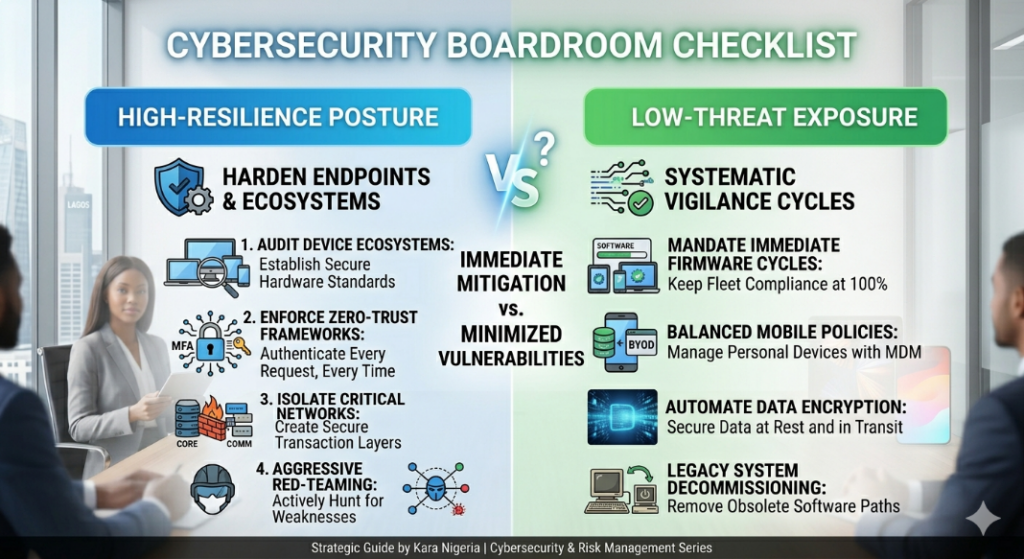
To shrink the corporate threat surface area before advanced public exploits mature, executives must execute four critical initiatives:
Immediate Mobile Firmware Standardization
With the boundaries between personal devices and corporate networks heavily blurred by modern communication applications, mobile operating system exploits are premium targets. Leadership must enforce a strict patch-compliance policy across all corporate and BYOD (Bring Your Own Device) smartphones.
Unpatched vulnerabilities are actively weaponized by automated scripts. Security teams must ensure that mobile endpoints are continuously updated to address known zero-day execution flaws. Executives can review the critical precedents of mobile posture maintenance in the recent briefing regarding critical iPhone vulnerabilities fixed in recent iOS updates, which underscores how rapidly unpatched code becomes a liability to corporate digital assets.
Implementation of Zero-Trust Architecture (ZTA)
Move away from the traditional perimeter security model (“inside the network is safe; outside is dangerous”). A Zero-Trust architecture assumes a breach has already occurred. Every user, device, and server must be continuously authenticated and verified, regardless of location.
Automated, Multi-Layered Data Encryption
All corporate data, both at rest and in transit, must use advanced cryptographic standards. If an AI-driven breach successfully exfiltrates corporate communications, intellectual property, or banking records, robust encryption ensures the stolen data remains unreadable and useless to the attacker.
Controlled AI Red-Teaming
Do not wait for malicious actors to deploy automated toolsets against your infrastructure. Forward-thinking C-Suites must authorize internal IT teams or external cybersecurity firms to conduct aggressive “red-team” simulations. Testing your own network defences against simulated advanced threats allows leadership to identify and remedy weak points before they are exploited.
4. Balancing Productivity with Ironclad Digital Defense
A common point of friction in executive decision-making is the perceived trade-off between strict cybersecurity controls and operational workflow efficiency. However, a secure posture can actively enhance productivity when implemented systematically.
| Operational Focus | The Vulnerability Surface | The Proactive Executive Fix |
|---|---|---|
| Remote Work / BYOD | Unmanaged networks, home Wi-Fi interception, shared household devices. | Corporate-issued, hardware-encrypted laptops; mandatory multi-factor authentication (MFA). |
| Legacy Infrastructures | Outdated software dependencies, unpatched server operating systems. | Continuous patch management pipelines; decommissioning obsolete legacy systems. |
| Mobile Access | Phishing via mobile messaging, unpatched OS-level remote code execution. | Centralized Mobile Device Management (MDM) enforcing immediate firmware compliance. |
| Data Repositories | Over-privileged access rights, unencrypted storage buckets. | Role-Based Access Control (RBAC) paired with automated data loss prevention (DLP) tools. |
5. Summary Checklist for the Boardroom
Before advanced, automated penetration tools reach public deployment networks, executive leadership must confirm the completion of the following structural shifts:
- [ ] Audit Device Ecosystems: Transition high-risk data environments to enterprise-vetted workstations and secure corporate hardware models.
- [ ] Mandate Immediate Firmware Cycles: Establish automated, non-optional software updates across all connected laptops and mobile fleets.
- [ ] Verify Network Segregation: Isolate core corporate operations and financial transaction layers away from standard employee communication networks.
- [ ] Enforce Zero-Trust Frameworks: Remove implicit trust parameters from your VPNs and local office intranets completely.
The corporate security actions taken over the coming months will differentiate resilient organizations from those vulnerable to next-generation digital threats. By shrinking threat surfaces now, business leadership across the globe and within Africa can confidently insulate their operations, capital, and data from evolving threat landscapes.